
India's eight core infrastructure sectors experienced a slowdown in production growth, reaching a two-month low of 4% in January. Crude oil and natural gas output declined, while refinery products remained flat. Overall growth for the April-January period was also lower compared to the previous fiscal year.

India's aviation sector is facing fresh turbulence, with rising fuel costs, the Ministry of Civil Aviation's free-seat directive, and geopolitical disruptions in West Asia clouding near-term earnings visibility.

Indian stock market benchmarks, Sensex and Nifty, saw gains in early trading, driven by anticipation surrounding the Reserve Bank of India's monetary policy decision, despite mixed global cues and significant FII outflows.
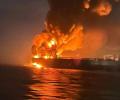
Ukraine claimed responsibility after explosions hit the vessels on Friday and Saturday.

The Indian government is dealing with the matter having in mind the national interests of this country in the first place, he said.

Fertiliser production dropped sharply by 11.5 per cent, crude oil by 5 per cent and natural gas by 0.9 per cent in October over the year-ago month

Sensex and Nifty post steepest weekly loss in over a year, falling nearly 3 per cent.

US President Donald Trump has threatened to target Iran's civilian energy infrastructure, including power plants, oil wells and Kharg Island, if Tehran does not reopen the Strait of Hormuz.

The decision by the Union government and the Reserve Bank of India to infuse Rs 1,25,000 crore (Rs 1,250 billion) into the banking system in the last two weeks alone is unlikely to fuel inflation, say economists, since this infusion will only meet the basic demand and not lead to a spillover.

'Once the market decides it wants to go up, it goes up -- no amount of bad news can really hold it back.'

Indian stock market benchmark indices closed higher, driven by strong performance in blue-chip bank shares and a positive trend in global markets, with hopes of progress in US-Iran peace negotiations also contributing to optimism.

The rupee appreciated 53 paise to close at 89.67 against the US dollar on Friday, supported by corporate dollar inflows and easing crude oil prices. Forex traders said a positive trend in domestic equities and Brent crude oil prices hovering near $59 per barrel supported the domestic unit at lower levels.

Foreign Portfolio Investors (FPIs) have withdrawn over Rs 62,853 crore from Indian equities in the first fortnight of June, bringing the total outflows for 2026 to Rs 2.87 lakh crore, surpassing the entire 2025 figure, driven by geopolitical tensions, global economic growth concerns, and a weakening rupee.

United States President Donald Trump on Wednesday said Prime Minister Narendra Modi had assured him that India would stop purchasing oil from Russia, describing it as "a big step" in efforts to increase global pressure on Moscow.

As Prime Minister Narendra Modi urges Indians to travel less, rising fuel prices are already changing driving habits.

US President Donald Trump on Thursday said that he has directed the country's Navy to take decisive action against any vessels attempting to lay mines in the strategically vital Strait of Hormuz amid escalating tension over the virtual control of the waterway between Tehran and Washington.

India's new manufacturing project announcements more than halved in the fourth quarter of FY26, falling 60 per cent sequentially and 78 per cent year-on-year to approximately 1.7 trillion, driven by global uncertainties, geopolitical conflicts in West Asia, and existing unutilised manufacturing capacity.

Gold has emerged as the most stable asset during episodes of geopolitical stress, and crude oil has been more sensitive than others when it comes to regional conflicts and sanctions, according to a report in the Reserve Bank of India's (RBI's) monthly bulletin. Silver and the United States Treasury have showed moderate reactions.

The rupee declined 31 paise to settle at 90.65 against the US dollar on Friday, weighed down by geopolitical uncertainties over the US-Iran talks, and a sharp rise in global crude oil prices.

Fixed deposits from nationalised banks delivered higher returns than equities, outperforming both inflation and stock market benchmarks.

Indian benchmark indices Sensex and Nifty closed marginally lower due to profit-taking, following the Reserve Bank of India's decision to keep the repo rate unchanged while lowering its growth expectations for the current fiscal year and forecasting higher inflation.

US President Donald Trump and Chinese President Xi Jinping met in Beijing to discuss a range of issues, including trade frictions and the war in Iran.

'What exactly is on the prime minister's mind, we do not know. But it feels like the government wants the country to be prepared for unseen challenges ahead.'
The government is considering building a strategic storage of crude oil to provide for a 45-day cover, Lok Sabha was informed on Thursday.
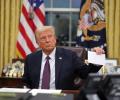
US President Donald Trump claimed India will stop buying oil from Russia, while also stating China will cut back substantially. He also discussed the conflict between India and Pakistan, reiterating his claim of helping settle the conflict.

India's unabated tryst with Russian crude oil is slowly coming to an end. The time has come for Indian refiners to navigate, creatively, the choppy waters of the post-honeymoon period, and for Indian policymakers to take cognisance of the broader impact on India from the spillover of the Russian crisis - after Washington's warning to transgressors last week. Shipments from Russia to India have averaged over 1.8 million barrels a day since February, according to data from Paris-based market analytics firm Kpler. But much of the crude shipped to India was non-sanctioned because it traded below a price cap set by the US led G-7 nations in December.

External Affairs Minister S Jaishankar has emphasised India's commitment to safe maritime transit and condemned attacks on merchant shipping amidst the ongoing West Asia conflict and global energy market disruptions.

Reliance Industries Limited (RIL) faced a challenging fourth quarter, with its energy business experiencing significant headwinds, leading to overall muted results and prompting analysts to adjust their outlook, even as consumer segments like Jio and retail demonstrated robust growth.
The country's fiscal deficit, as a percentage of GDP, would be wiped out if the crude oil price, as measured with the Indian basket, touch $80 per barrel.

S&P Global Ratings has increased India's GDP growth forecast for the next fiscal year to 7.1 per cent, citing private consumption, investment, and exports as key drivers. However, the agency also cautioned that the conflict in the Middle East could strain India's fiscal position due to higher energy prices.
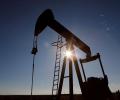
A fall in crude oil price and Aramco's $75 billion annual dividend commitment may have delayed Saudi company picking a stake in Reliance Industries Ltd's oil-to-chemical unit (O2C), research firm Jefferies said. Richest Indian Mukesh Ambani had in August 2019 announced talks for the sale of a 20 per cent stake in the O2C business, which comprises its twin oil refineries at Jamnagar in Gujarat and petrochemical assets, to the world's largest oil exporter. The deal was to conclude by March 2020 but has been delayed for reasons not disclosed by either company.

Indian benchmark indices, the BSE Sensex and NSE Nifty, snapped a four-day losing streak, with the Sensex climbing 382 points, primarily driven by a strong rally in IT sector shares. Major IT firms like TCS, Infosys, and HCL Tech saw significant gains, contributing to the market's recovery.

China has called on Iran to reopen the Strait of Hormuz and expressed appreciation for Tehran's commitment not to develop nuclear weapons, a key demand of the US to end the conflict.
'In all these years of rupee depreciation, of rising oil prices, of inflation caused by import dependence, not one leader had the courage to look the people in the eye and say: Please do this for your country.'

The vessels are carrying around 92,600 metric tonnes of LPG and have 33 and 27 Indian seafarers onboard, respectively. Visuals showed Pine Gas crossing the critical chokepoint.

The Indian government has directed oil refineries to increase LPG production to ensure a stable supply of domestic cooking gas, amidst concerns over potential disruptions from the escalating Middle East conflict and its impact on imports.

The ongoing oil price decline is mainly a result of oversupply in the global market

Or Iran may face the risk of losing its biggest client

Indian basket at 6-month low of $49.11 a bbl
